Twin Bridges Montana
Community Overview
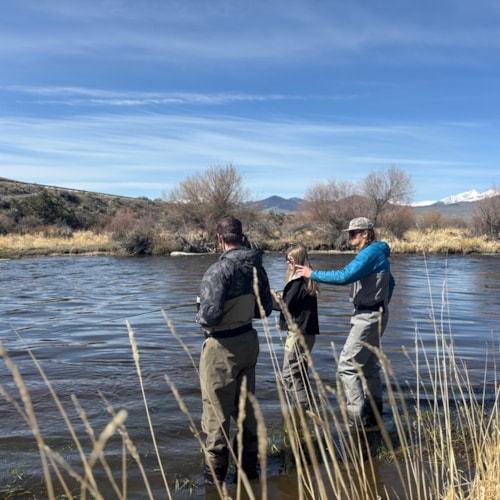
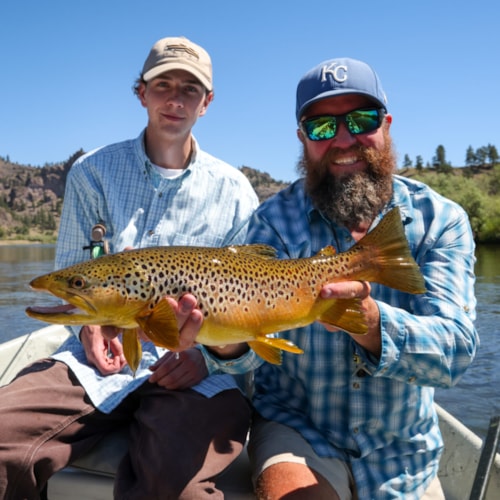
Today, the Twin Bridges area has far more than two bridges. Water defines the existence of Twin Bridges. The Big Hole, Beaverhead, and Ruby Rivers all converge near Twin Bridges to form the Jefferson. These four blue ribbon trout streams offer a diversity of fishing experiences, from the expansive Jefferson to the more intimate banks of the Ruby. If fishing seems too involved, take a float trip down any of the rivers, enjoying the beautiful scenery of lush ranchland around Twin Bridges.
There are lots of other places to fish and float, but are there other places you can take part in the Floating Flotillas Fish Fantasy river parade? This unique event, sponsored by the Greater Ruby Valley Chamber of Commerce and Agriculture, includes a floating parade, pasture golf, a three-on-three basketball tournament, and much more. The parade would add a one-of-a-kind flair to any Montana adventure. For a taste of the Ruby Valley, check out the Twin Bridges Farmers' Market, on Saturdays from May to September. The market features produce and crafts from local vendors. A trip in Montana wouldn't be complete without a fair and rodeo, and Twin Bridges' annual Madison County Fair is one of the best around. As a fishing and ranching community, Twin Bridges is the perfect location for two top-of-the-line vendors: the R.L. Winston Rod Co. has made premium fishing rods since 1929, and Montana Mad Hatters specializes in top quality custom made cowboy hats. With fantastic fishing, and unique events, Twin Bridges is the perfect place to stage a Montana adventure.
Community Info
Twin Bridges Elevation: 4,626'
Twin Bridges Population: 330 (2020)
County: Madison
Ruby Valley Chamber of Commerce Twin Bridges Farmers Market Outlaws, Gold & Ghost Towns 4 Day ItineraryIn the Twin Bridges, MT Area:
Get Out and Explore.
A Gathering of Three Rivers: Beaverhead River, Ruby River, Big Hole River Twin Bridges, Montana
“…we encamped on the river bank on Lard. side having traveled by estimate 23 Miles. The fish of this part of the river are trout and a species of scale fish of a while [white] colour and a remarkable small long mouth which one of our men inform us are the same with the species called in the Eastern states bottlenose. [8] the snowey region of the mountains and for some distance below has no timber or herbage of any kind; the timber is confined to the lower and middle regions …Capt. Clark set out this morning as usual. he walked on shore a small distance this morning and killed a deer. in the course of his walk he saw a track which he supposed to be that of an Indian from the circumstance of the large toes turning inward. he pursued the track and found that the person had ascended a point of a hill from which his camp of the last evening was visible; this circumstance also confirmed the beleif of it’s being an Indian who had thus discovered them and ran off. they found the river as usual much crouded with islands, the currant more rapid & much more shallow than usual. in many places they were obliged to double man the canoes and drag them over the stone and gravel.”
Meriwether Lewis – Journal entry August 3, 1805 – passing through the Jefferson Valley to where it opens up to the south – camping near todays Twin Bridges
Named for the two bridges built by brothers Judge Mortimer Lott and John Lott in southwest Montana, Twin Bridges sits at the confluence of the Big Hole, Ruby and Beaverhead rivers forming the Jefferson River forms where the Jefferson River Valley transitions to the sprawling Beaverhead Valley. The Tobacco Root Mountains rise quickly to the east and the Highlands with their gradual ascent are to the northwest.

Shoshone and Bannock indigenous people whose home ground was far southwest Montana, trailed through the area on their hunting expeditions usually going to the Three Forks to meet other tribes to “Go to Buffalo”. And the Corps of Discovery passed the future townsite on August 3, 1805, and William Clark on the return camped near Twin Bridges on July 11, 1806.
Originally from Colorado, the Lott brothers came to the site in 1864, and settled the town in 1867 as felt the area had fertile soils and could prosper. They also noted that four Indian trails converged at a natural crossing site of the Beaverhead and Big Hole rivers. With that knowledge they built two toll bridges that crossed the rivers. Twin Bridges had its beginnings.
Prior to the Lotts, in the 1850s, Richard Grant a former Hudson’s Bay Company agent, pioneered a ranching community in the surrounding area. He settled at the meeting of the Beaverhead and Ruby rivers and established a post to trade with Native Americans.
Occasionally some prospectors and trappers who journeyed through the region abandoned their weakened oxen. Grant found the animals in the spring, fully recovered and fat. They had wintered well on the basins’ rye, rough fescue, and blue bunch wheatgrass; all grew abundantly in the mountain valleys of Montana.
To add to his business, he travelled south into present day Idaho, south of Pocatello, to meet wagon trains traversing the Oregon Trail. Here he exchanged healthy livestock, such as the oxen, for exhausted animals. He swapped one healthy cow for two worn-out cattle to bring them north to recover in the valleys and trade again; of course, money or furs was also involved.
Montana’s cattle industry grew from these simple beginnings. Miners hunting for gold in the nearby mountain ranges needed to eat; agriculture and mining grew a community.
Between 1894 and 1975 Twin Bridges was the location for the state’s orphanage. Petitioned by Judge Lott, J.M Paige and Pat Carney, in 1894 the first children, five of them, were sent to the facility. The intentions of the orphanage were to provide relief for youth trapped in an unhealthy living situation from poverty-stricken areas and prepare them with life skills unavailable to them before.
Over its life, in reality only about five percent of the approximate 5,900 children who spent time there were orphans. Eventually the name was changed to the Montana Children’s Center.
At the turn of the 20th century, Progressive Era reformers argued orphanages did more harm than good and encouraged government intervention. Pivoting away from orphanages, solutions of government funded programs providing families for children instead of group homes were introduced. Due to these legislative changes, the orphanage closed in 1975. The buildings are now privately owned and for the most part in disuse.

Today Twin Bridges can brag of gathering three of Montana’s celebrated trout waters. Here the Beaverhead, Ruby and Big Hole rivers merge their flow to form the Jefferson River that then surges for 83 miles to meet the Madison and Gallatin Rivers at Three Forks. Together they give up their names to go forth as the Missouri River. Indeed, it’s a go to mecca for trout fishing. The Winston Rod Company that sells everything one needs for a fly-fishing, is located in Twin Bridges and is its major business employing 30 people. And this Beaverhead Valley community is growing in importance to long-distance biking enthusiasts.
In 2009 at Jessen Park on the banks of the Beaverhead, a bike camp was built. Here cyclists can rest, buy food, take a shower, and have a place to stay for the night.
Atelier art studio, another visitor attraction showcases artwork inspired by the region’s beautiful scenery and nature. A piece of this natural geography that accentuates the setting are the Tobacco Root Mountains rising a short distance from Twin Bridges east edge.
Rugged, with many high-country recreation opportunities, the range holds 43 summits that reach beyond 10,000 feet. Hollowtop at 10,604 feet is the highest pinnacle. Access is best gained out of Sheridan, about 10 miles southeast of town. Roads from there lead to backcountry trails and the many alpine lakes.
For maps and information, the US Forest Service Butte-Jefferson Ranger District – 406 494 – 2147 is the place to start.
Montana’s formative years played out in this place of mountains and wide valleys. The Corps of Discovery, indigenous peoples, fur trappers, gold-seekers and outlaws left their footprints in the soil of the Beaverhead and Ruby valleys. Reminders of the past are found in interpretive signs located in the bike camp and the Madison County Fair Grounds just across the road.
Whether it is to fish, hike in the Tobacco Root or follow historic by-ways of the area, Twin Bridges, home to 250 people is located far from the fast lane is worth a few days visit.