




Hollowtop Mountain
Sentinel of the Tobacco Root Mountains
By Elanor Kimble
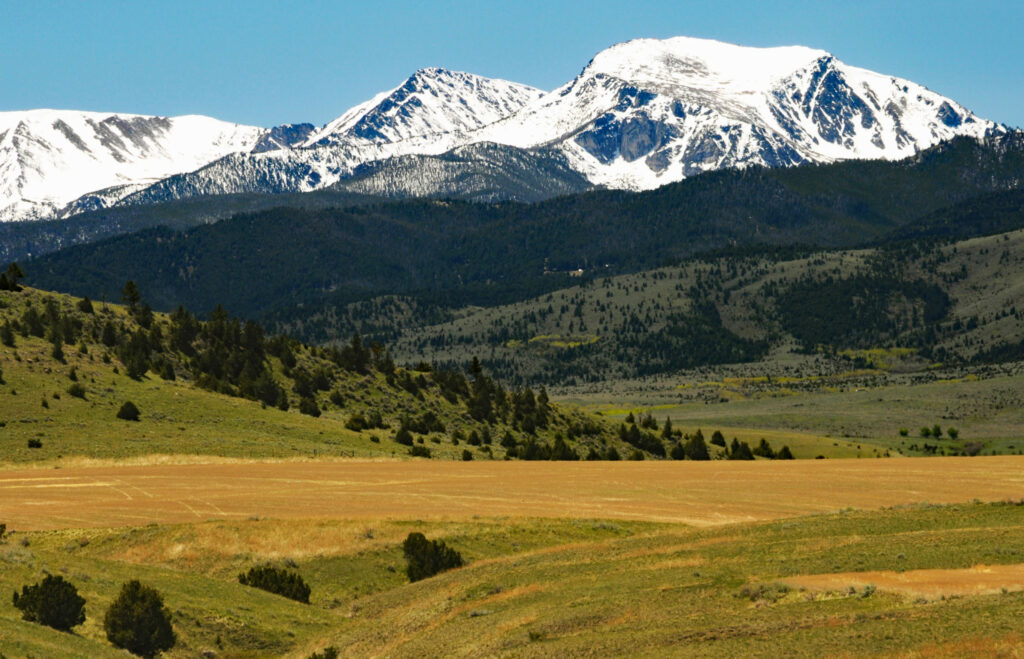
Hollowtop Mountain, 10,604 ft, rises in Southwest Montana’s Tobacco Root Mountains and the Beaverhead-Deerlodge National Forest. Travelers can find services in the nearby towns of Harrison, Norris, and Whitehall. For more information on the conditions of trails, reservations for camping, and weather, you can contact the Beaverhead-Deerlodge National Forest supervisor’s office in Dillon, Montana: 406-683-3900
One route to the summit starts at the North Willow Creek Trailhead, located outside the town of Pony. The trail itself doesn’t lead to the top, but first reaches Hollowtop Lake on a well-marked trail. From there, it’s off-trail and requires a bit of bushwhacking following the banks of the three lakes near the summit, including Hollowtop Lake, Deep Lake, and Skytop Lake.
A spur trail leads to the north end of Hollowtop Lake, but after that, it will be all off-trail and then a steep scramble on loose rocks to the summit.
This is a challenging hike that takes seven hours one way and requires extensive off-trail navigation and scrambling. It is recommended for experienced hikers. The road to the trailhead can also be impassable in winter due to snow, even for four-wheel vehicles. This should be considered before planning a trip.
An alternative route exists, as outlined in the book Peakbagging Montana by Cedron Jones from Cardwell, Montana, which is taken from the north side of the Tobacco Root Mountains. For more information on this route, visit the Nature’s Course website and Aaron Schye’s article on this route, which includes directions and a KML file.
The geology of the Tobacco Root Mountains is primarily composed of ancient metamorphic rocks intruded by the later Tobacco Root Batholiths, or granite plutons. This has made the mountains very rich in mineral deposits, such as gold. Glaciers from the last ice age shaped valleys and peaks.


